

AI Training Data Provenance: What Onchain Records Prove
DATA Network’s Trace logs where AI training data came from. An onchain receipt proves a file was registered. It does not prove anyone had the right to share it.
DATA Network’s Trace logs where AI training data came from. An onchain receipt proves a file was registered. It does not prove anyone had the right to share it.

Circle’s Arc launched with agent wallets and sub-cent USDC payments. The tools are real. The agent demand they were built for is still small.
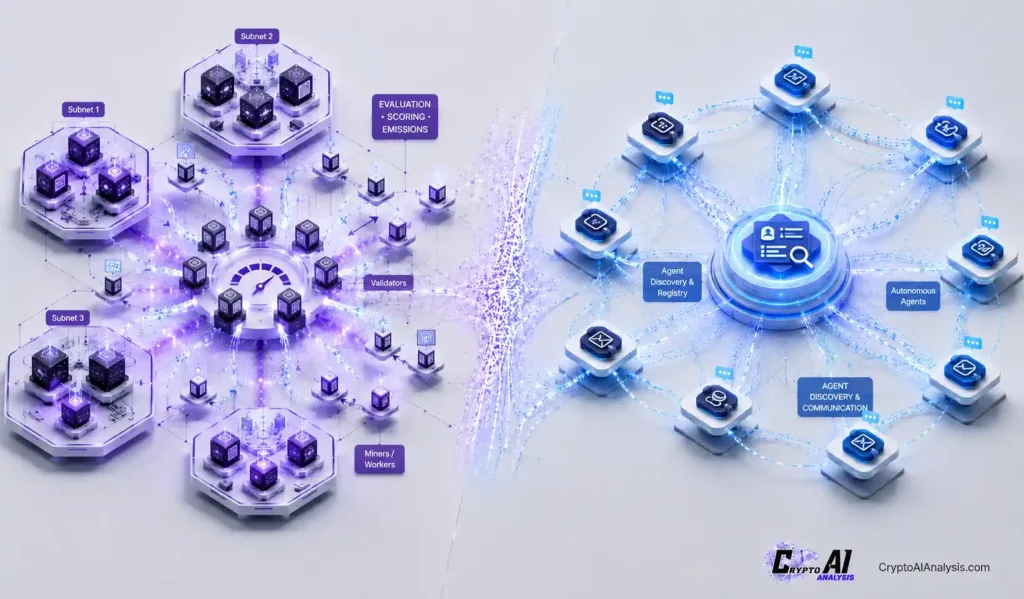
Bittensor and Fetch.ai’s uAgents get lumped into the same ‘decentralized AI’ category constantly, but they solve completely different problems. Here’s what actually separates a subnet-based incentive market from a Python agent framework, and where each one’s real risks lie.

ERC-8004 has drawn more than 170,000 registered AI agents across Ethereum, BSC, and Base within months. New empirical data reveal how few expose a live service endpoint, and how coordinated Sybil behavior is already undermining on-chain reputation.

Prime Intellect just raised $130M at a $1B valuation without launching a token, while unrelated copycat coins trade under its name on two different chains. Here’s what the company actually built, and why conflating the two is costing people money.

Akash Network is being forced off its own Cosmos chain by a hostile license change, even as its Burn-Mint Equilibrium ties AKT directly to AI compute demand. Here is the honest 2026 picture, providers and all.

AI agents can now hold wallets and spend crypto without asking permission first. Here’s how the actual payment infrastructure works, what’s live today, and the security risks most coverage skips over.

NEAR Protocol’s founder helped invent the Transformer architecture behind modern AI, and the chain he built since is now positioning itself as the settlement layer for AI agents. Here’s what’s real, what’s thin, and what the token actually does.

Gensyn launched its mainnet and AI token within the same week, immediately drawing attention across the decentralized AI infrastructure space. This analysis explores Gensyn’s verification architecture, Delphi platform, tokenomics, and the risks most coverage ignores.

Tokenizing real estate or bonds is the easy part. Keeping those tokens honestly priced and risk-monitored after the fact is where most projects stall, and that’s the gap AI is actually built to close.